

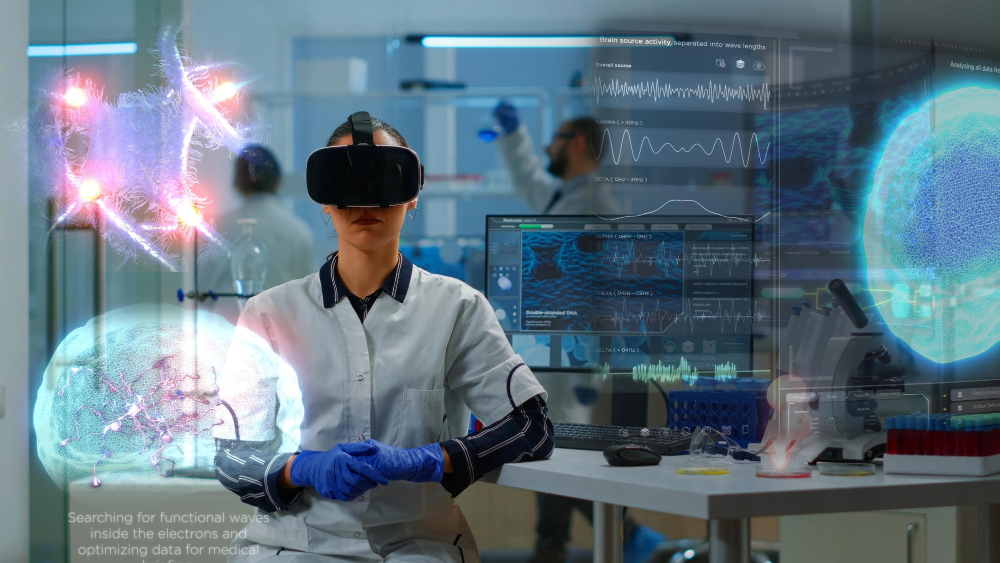
Quantum Technology Revolutionizing Diagnostics and Treatment
AI-Augmented Quantum Technology Revolutionizing Diagnostics and Treatment
The healthcare industry stands at the cusp of a revolutionary transformation, powered by the convergence of two cutting-edge technologies: Quantum Technology and Artificial Intelligence (AI). Together, these technologies are redefining the boundaries of medical diagnostics and treatment, promising earlier disease detection, personalized therapies, and enhanced patient outcomes. This blog explores the groundbreaking impact of AI-augmented quantum technology in healthcare and the path ahead.
Understanding the Foundations: Quantum Technology and AI
What is Quantum Technology?
Quantum technology exploits the strange yet powerful principles of quantum mechanics—such as superposition (particles existing in multiple states simultaneously), entanglement (instant connections between particles over distances), and quantum coherence—to build devices that perform tasks beyond classical capabilities. In healthcare, this translates to ultra-sensitive sensors, quantum-enhanced imaging systems, and quantum computing platforms capable of complex molecular simulations.
The Role of Artificial Intelligence
AI, especially machine learning and deep learning, excels at handling massive amounts of data, finding hidden patterns, making predictions, and automating complex decision-making processes. In medicine, AI has already shown promise in analyzing medical images, predicting disease risks, and aiding clinical decisions.
The Synergy of AI and Quantum Technology
When AI meets quantum technology, the combined potential multiplies exponentially. AI algorithms can optimize quantum devices, interpret complex quantum-generated data, and enhance the precision of quantum sensors. Conversely, quantum computing can accelerate AI by tackling computationally intensive problems far beyond classical computers’ reach.
Quantum Sensors and AI: Transforming Diagnostics
Traditional diagnostic tools sometimes struggle to detect diseases at very early stages or at low biomarker concentrations. Quantum sensors change this paradigm.
Quantum Sensors’ Capabilities
Quantum sensors exploit the extreme sensitivity of quantum states to detect minute changes in magnetic, electric, or optical fields. For example:
- Quantum magnetometers can measure the brain’s faint magnetic fields, enabling better understanding and early detection of neurological diseases.
- Quantum-enhanced biosensors can detect single molecules or biomarkers related to cancer, infectious diseases, or cardiovascular conditions.
How AI Enhances Quantum Sensors
The raw data from quantum sensors is often complex and noisy. AI algorithms help by:
- Filtering out noise and enhancing signal clarity.
- Identifying subtle biomarker signatures that might indicate early disease stages.
- Continuously learning from new data to improve diagnostic accuracy over time.
Real-World Example
Researchers are developing AI-augmented quantum magnetometers to map brain activity at unprecedented resolutions. This technology holds promise for diagnosing Alzheimer’s and Parkinson’s diseases years before symptoms manifest.
AI and Quantum Computing: Accelerating Drug Discovery and Personalized Medicine
The Challenge of Drug Discovery
Designing new drugs is a lengthy, costly process. It requires understanding how molecules interact at an atomic level, which is computationally demanding.
Quantum Computing’s Role
Quantum computers simulate molecular interactions using quantum mechanics, providing a more accurate and faster approach to predicting drug behavior, efficacy, and safety.
AI-Quantum Synergy in Drug Discovery
AI algorithms guide quantum simulations by:
- Selecting promising molecular structures to analyze.
- Predicting outcomes from simulation data.
- Integrating patient-specific genomic and proteomic data to tailor treatments.
This approach not only accelerates drug discovery but also facilitates personalized medicine, ensuring therapies are customized for an individual’s unique biology.
Quantum Imaging Enhanced by AI: Sharper Medical Insights
Medical imaging is a cornerstone of diagnostics. Quantum technology enhances imaging capabilities beyond classical limits:
- Quantum-enhanced MRI and PET scans offer higher resolution and contrast.
- Quantum optics techniques improve imaging at the molecular level.
AI processes this wealth of imaging data by:
- Enhancing image quality through noise reduction and contrast improvement.
- Automating anomaly detection, reducing human error.
- Tracking disease progression with predictive analytics.
- The result is faster, more accurate diagnoses and improved patient monitoring.
Securing Health Data with AI-Driven Quantum Cryptography
Healthcare data breaches are increasingly common, threatening patient privacy. Quantum cryptography offers unbreakable encryption based on the laws of physics, not just computational difficulty.
When combined with AI’s ability to detect suspicious network behavior and respond in real-time, this creates a robust defense system ensuring patient data confidentiality and trust in digital healthcare.
Challenges and Future Outlook
Despite its promise, AI-augmented quantum technology faces several challenges:
- Hardware Limitations: Quantum devices are still in their infancy, requiring improvements in stability, scalability, and error correction.
- Algorithm Development: Crafting AI algorithms tailored for quantum data and optimizing quantum algorithms remains a work in progress.
- Interdisciplinary Collaboration: Bridging the knowledge gap between quantum physicists, AI experts, and healthcare professionals is essential for practical deployment.
- Regulatory and Ethical Issues: The integration of these technologies must address patient safety, ethical concerns, and regulatory compliance.
However, significant investments and international collaborations are rapidly accelerating progress.
Conclusion: A New Era in Healthcare
The integration of AI and quantum technology represents a paradigm shift in diagnostics and treatment. This fusion promises earlier disease detection, faster drug discovery, more personalized therapies, and robust data security—outcomes that could dramatically improve global health.
As research matures and these technologies become more accessible, healthcare providers will be empowered with tools of unprecedented precision and power, heralding a new era where diseases are detected sooner, treatments are tailored better, and patient outcomes are significantly improved.